menu
logo
Blog Courses DevOps Success Stories AI Avatar Login

Kubernetes Upgrade Impacts

Today, let’s explore Kubernetes v1.34 upgrade. What’s New in Kubernetes, What Changed, and Why You Should Upgrade and How is it different from previous v1.33 version.

Introduction

Kubernetes releases v1.34, which delivers substantial enhancements focused on improving performance, security, and resource management without any major API deprecations or breaking changes. This makes it a relatively safe, yet impactful, upgrade from v1.33.

Explanation of each Feature and Upgrade Impact

Let’s explore one by one each feature and Key changes

Dynamic Resource Allocation (DRA)

Before in v1.33

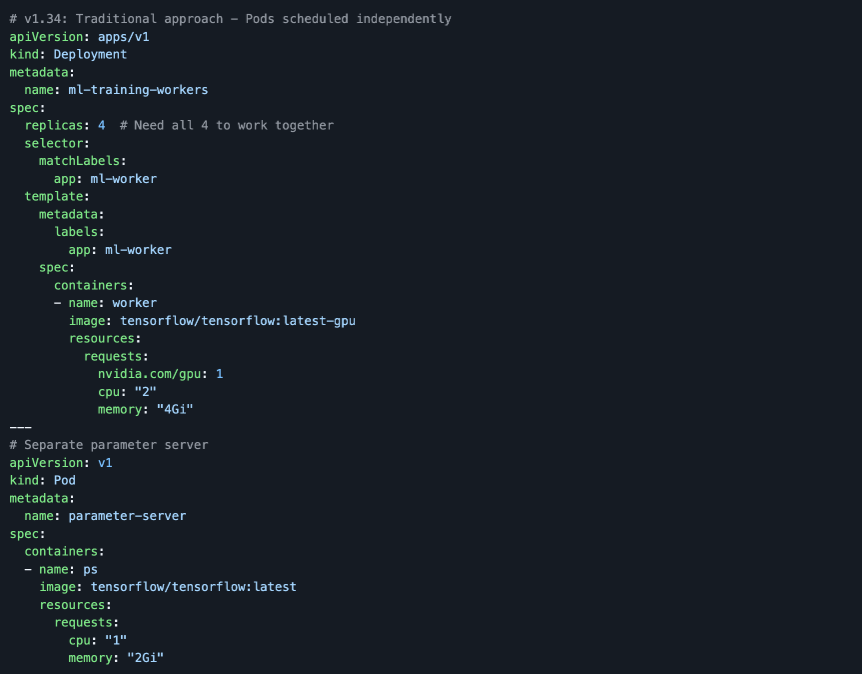
APIs there were limitations for management of GPUs and TPUs. The primary limitation was inefficient utilization a pod would request a whole GPU, and no other pod could use that GPU even if it was only using a fraction of its capacity. No fine-grained resource management.

In v1.34

Now there’s a stable Dynamic Resource Allocation APIs for GPUs, TPUs, NICs, etc available by default.This adds powerful, structured resource claims management enabling better scheduling and resource sharing.

Impact & Key Changes:

Standardized Management: DRA provides a powerful, vendor-neutral framework for workloads to claim specific hardware resources dynamically.

Fine-Grained Control: It enables sophisticated resource sharing and better scheduling decisions, moving beyond the all-or-nothing approach of the past.

Better Utilization: For AI/ML, HPC, and networking workloads, this means vastly improved hardware utilization and more reliable placement of specialized workloads across the cluster.


Enhanced Security via Short-Lived Service Account Tokens

Previously, nodes used long-lived credentials stored as Secrets for pulling private images. These credentials never expired and were difficult to rotate, creating security risks.

Now (in v1.34):

A major security enhancement is that the kubelet can use short-lived, audience-bound ServiceAccount tokens that are automatically rotated. This enables image pulls based on the Pod's identity rather than node-level credentials.

Impact

Zero-Trust Aligned: This brings Kubernetes closer to a zero-trust security model for image delivery.
Reduced Risk: It significantly lowers the blast radius in the event of a credential leak.

Simplified Management: Cluster operators no longer need complex rotation policies for static image pull secrets.


Pod-Level Resource Requests and Limits

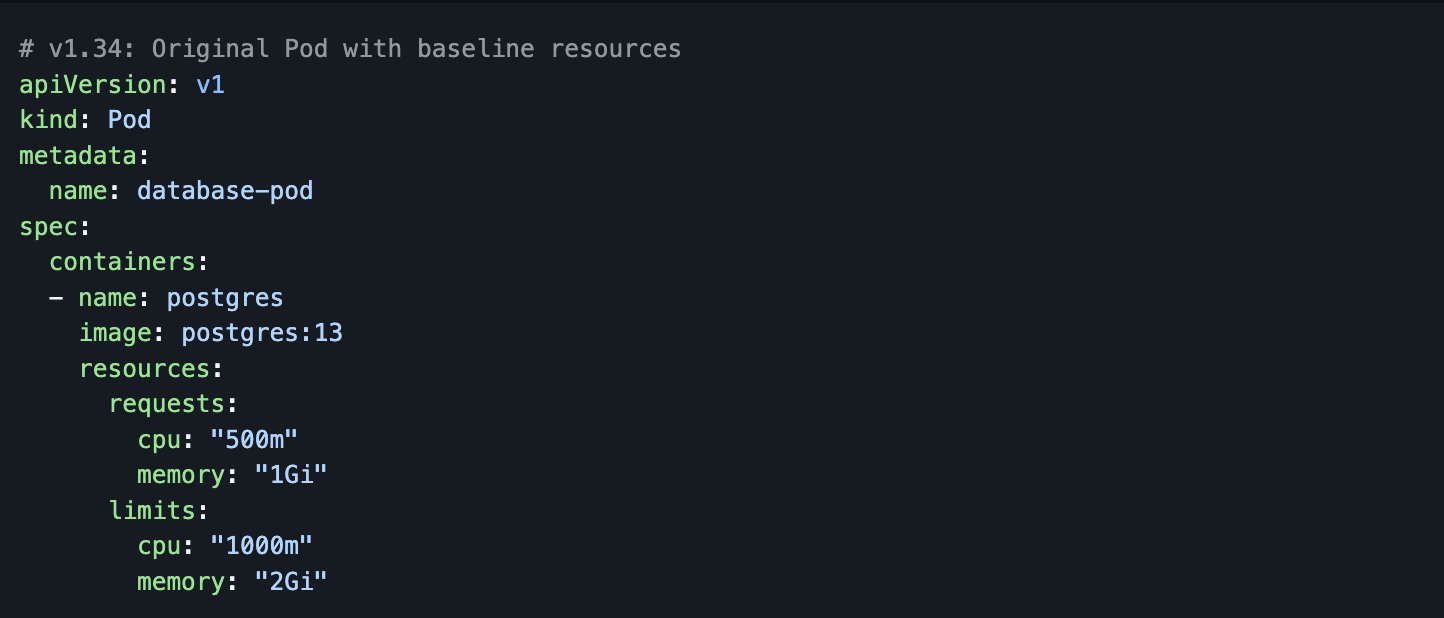
Before, Pod-Level Resource management was strictly Container-level, which created isolated resource silos. Each container within a multi-container Pod (like those using sidecars) required individual CPU/memory limits that couldn't be shared, leading to resource waste when some containers were idle while others needed more resources. No dynamic resource redistribution within pods.

Now (in v1.34):

This feature is enabled by default in v1.34. Pod-level resource pools enable containers to share CPU and memory from a common pod allocation. Containers can dynamically use unused resources from other containers in the same pod, improving resource utilization and reducing waste in multi-container applications.

Impact:

This change simplifies configuration and dramatically improves efficiency for multi-container applications:
Dynamic Redistribution: Containers can now dynamically use unused CPU and memory from the common Pod allocation, preventing resource starvation within the Pod boundary.

Improved Utilization: This leads to better overall cluster utilization and more efficient scheduling.

Simpler Configuration: Operators no longer need to meticulously calculate and divide total required resources among individual containers, streamlining the deployment process.


Node Memory Swap Support

Previously, Kubernetes required swap to be disabled on all host nodes by default. If swap was enabled, the kubelet would simply refuse to start. This "no swap" policy often led to abrupt Out-Of-Memory (OOM) kills for applications that experienced temporary memory spikes but could otherwise function adequately with swap space. This rigid approach was particularly challenging in resource-constrained environments like edge computing.

Now (in v1.34):

Node Swap support is now a stable, Generally Available feature in v1.34. The default behavior is still "swap off," but cluster administrators can explicitly configure the kubelet to use swap with specific guardrails.

Impact & Key Changes:

This significantly enhances workload stability and offers greater flexibility in managing host machine memory:

Enhanced Stability for Burstable Pods: Burstable QOS class Pods can now utilize the host node's swap space within their defined limits, preventing sudden OOM terminations.

Guarded Usage: The feature ensures that Guaranteed QOS Pods (which expect dedicated resources) cannot use swap, maintaining performance predictability.

Edge Case Optimization: This is a major win for environments where nodes have limited RAM (e.g., IoT/edge devices), allowing operators to run a broader range of workloads reliably.

Explicit Control: Administrators use the KubeletConfiguration API to opt into enabling and configuring swap behaviour securely.


Job Pod Replacement Policy

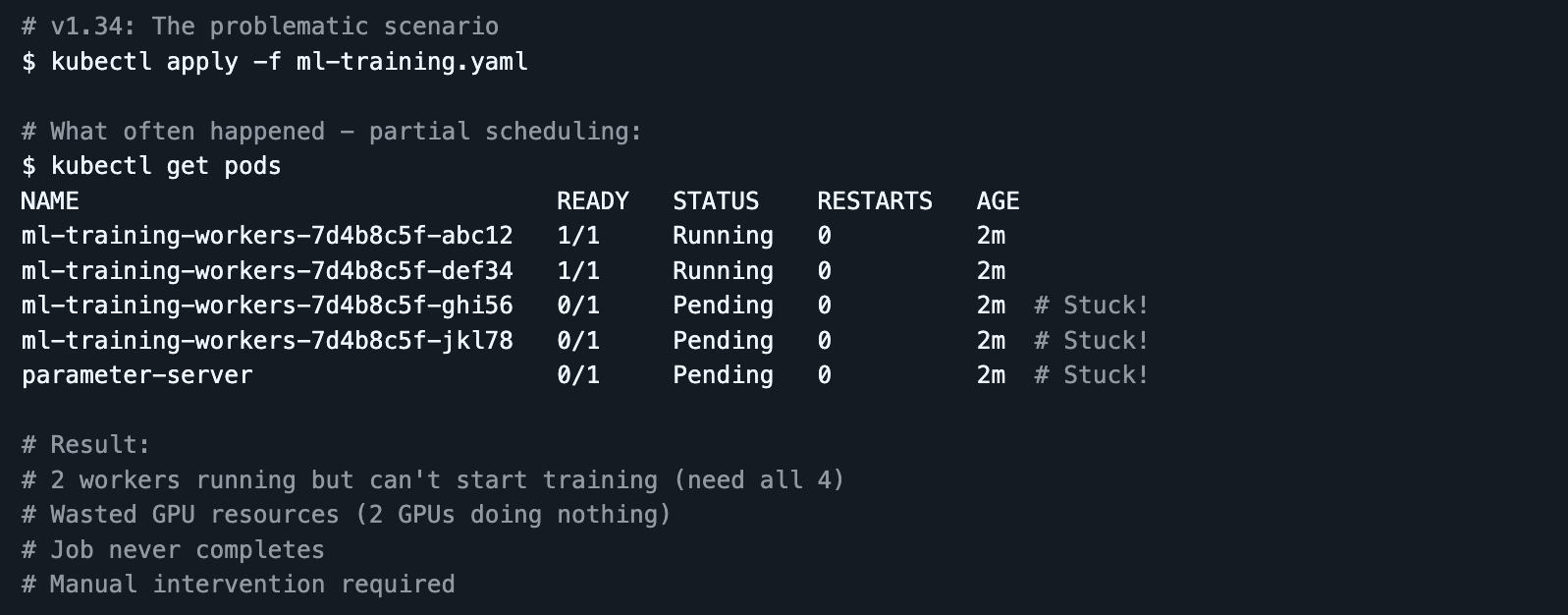
Before, The job controllers would create replacement Pods immediately when old Pod starts terminating. This results in both the old (terminating) and new (pending) Pods existing at the same time, even if they aren't both running in the traditional sense causing resource conflicts, unwanted cluster autoscaling, and inefficient resource usage, especially problematic for ML/AI workloads requiring exclusive resource access.

Now (in v1.34):

The PodReplacementPolicy allows Job Controllers to only create replacement pods when the failed pod is completely terminated (status phase Failed), and free up its resources for new replacement pods to be created. This feature gives you more control over the timing of Pod replacements.This prevents resource overlap, reduces cluster autoscaler triggers, and ensures clean resource handover. Critical for workloads that require single pod per index or exclusive resource access. Introduced as alpha in v1.28, this feature has now graduated to stable in v1.34.

Impact:

Operators can now configure the Job controller to wait until the failed or terminating Pod is completely terminated (in the Failed status phase) and its resources are fully freed up before creating a new replacement Pod.

Prevents Resource Overlap: Ensures clean resource handover and avoids contention within tight clusters.

Efficient Autoscaling: Reduces unwanted cluster autoscaler triggers caused by temporary resource spikes during the overlap period.

Critical for Indexed Workloads: Guarantees compatibility with frameworks and workloads that strictly require only one Pod per index or exclusive resource access at any given time.


Introduction of KYAML

Earlier, Kubernetes has always relied heavily on YAML for configuration, a format known for its flexibility but also its notorious pitfalls. Issues like implicit type coercion (the famous "Norway Problem," where NO can be interpreted as a boolean false), ambiguous syntax, and sensitive whitespace often lead to hard-to-debug configuration errors and fragility in tooling and GitOps pipelines.

Now (in v1.34):

Kubernetes v1.34 introduces the Kubernetes YAML (KYAML) dialect as an Alpha feature. KYAML is a stricter, safer subset of standard YAML designed specifically to eliminate these common errors and ambiguities. It is available within kubectl via an environment variable flag (KUBECTL_KYAML=true).

Impact:

While still an alpha feature that requires explicit activation, KYAML offers a glimpse into a future of more reliable Kubernetes configurations:

Safer Parsing: It removes implicit type coercion, ensuring that values like yes, no, or numbers with leading zeros are treated as strings by default, preventing unexpected behaviour.

Reduced Errors: By adopting a stricter syntax, it aims to significantly reduce the number of human-introduced configuration errors.

Improved Tooling Support: This standardized, predictable format makes life easier for CLI tools, GitOps controllers, and configuration management systems (like Kustomize and Helm), resulting in more robust automation.


Finer-grained Authorization

Before, Authorization was based only on basic attributes like resource type, verb (e.g., get, list), namespace, and resource name. There was no standardized way to restrict API actions based on selectors. Broader permissions had to be granted, the kubelet on a node might need permission to list all Pods in a cluster just to find its own, creating a security exposure.

Now (in v1.34):

Authorization decisions can now use field and label selectors in requests(eg: list, watch, deletecollection). Enabling precise and restrictive access control policies. This allows administrators to set up least-privilege rules, such as only allowing a client (like the kubelet) to list Pods bound to its specific node.

Impact:

This enhancement enables the implementation of precise, least-privilege access control policies:

Precise Access Control: Authorization decisions for batch requests (like list, watch, and deletecollection) can now evaluate the selectors included in the request.

Zero-Trust Node Isolation: This is a critical security win. Administrators can now enforce rules that only allow a client (like the kubelet) to list Pods if the request explicitly includes a field selector for spec.nodeName matching its own node.

Secure Multi-Tenancy: The feature is ideal for custom multi-tenant clusters where you need to scope access down to specific subsets of resources based on labels, without granting access to everything in the namespace.


VolumeAttributesClass

In previous versions, Volume attributes were static and immutable after creation. To change IOPS, throughput, or storage type, you had to delete and recreate the entire volume, causing downtime and data migration complexity. No dynamic storage performance optimization possible.

Now (in v1.34):

VolumeAttributesClass API enables dynamic modification of volume attributes at runtime. You can now change IOPS, throughput, storage type, and other parameters without recreating volumes or restarting pods. This enables automated storage performance scaling and cost optimization based on workload demands.

Impact:

While an alpha feature, this lays the groundwork for seamless, automated storage management:

Dynamic Modification: It enables the modification of parameters like IOPS, throughput, or storage type at runtime without requiring the deletion and recreation of volumes or the restarting of Pods.

Automated Scaling and Optimization: This facilitates automated storage performance scaling and cost optimization that can react dynamically to changing workload demands (e.g., boosting IOPS during a busy reporting period and scaling it back down afterward).

Reduced Downtime: Eliminates the operational complexity and downtime associated with manual storage migrations.


Conclusion

Key changes include major graduations to stable for features like Dynamic Resource Allocation (DRA), node swap support, and fine-grained authorization, alongside new beta and alpha features that streamline operations and enhance security postures for modern AI/ML and multi-tenant workloads.


Happy Learning!

Pooja Bhavani
DevOps and Cloud Engineer at TrainWithShubham

Terms of use Privacy policy About us FAQs Contact us Refund policy
𝕏
Cart ( Items )
There are no items in your cart
Add More
Item Details Price
You may also be interested in
Note: Promo Codes can be applied after checkout
Total Amount $0
Add More Checkout
Review